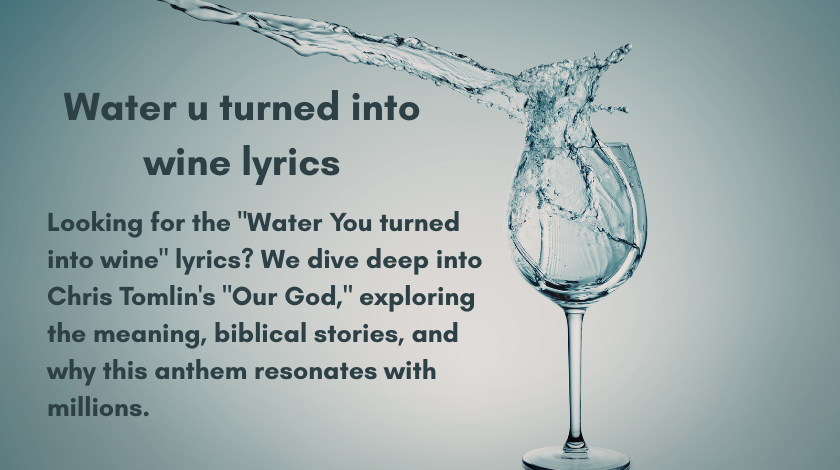
If you have stepped into a modern church service anytime in the last ten or fifteen years, you have almost certainly heard a very specific, melodic piano intro followed by the line, “Water You turned into wine.” It is one of those opening lyrics that instantly grabs your attention because it paints a vivid picture right from the start. You are not just hearing a song; you are being transported back to a specific moment in history. While many people search for these words online just to find the text, there is so much more to discover about where this song comes from and why it has become a staple in Christian music. The song is titled “Our God,” and it was popularized by worship leader Chris Tomlin, though it was a collaborative effort by some of the best songwriters in the genre.
In this article, we are going to look closely at these lyrics. We are not just going to list them out, but we are going to explore the stories behind the words. When you sing “Water You turned into wine,” you are referencing the very first miracle Jesus ever performed. When you sing “Our God is greater,” you are joining a global chorus of people declaring hope. I want to take you through the verses, the chorus, and that powerful bridge to help you understand why this song is so special. Whether you are a worship leader, someone looking for spiritual encouragement, or just curious about the song you heard on the radio, this deep dive is for you.
The Origins of the Anthem
Before we get into the specific line about water and wine, it is helpful to understand who put this masterpiece together. The song “Our God” was released around 2010 and is associated with the Passion movement. This is a massive gathering of young people that happens annually, and the music that comes out of it usually shapes what churches sing for the next decade. The credits for this song include heavy hitters like Chris Tomlin, Matt Redman, Jonas Myrin, and Jesse Reeves. When you have that many experienced worship leaders working on one track, you usually end up with something that is easy to sing but deep in meaning.
I remember when this song first came out. It felt different because it was so simple yet so big. It did not try to use complicated poetry or archaic language. It just stated facts about God. The goal of the songwriters was clearly to create an anthem that anyone could sing, regardless of where they were on their spiritual journey. It went on to win awards and top charts, but its real success is that millions of people know the words by heart. It is a song that focuses entirely on the character of God rather than the feelings of the singer, which is perhaps why it has stood the test of time so well.
Analyzing Verse 1: The Miracles
Now, let us look at that famous opening verse that everyone searches for. The lyric is: “Water You turned into wine, open the eyes of the blind.” This is a direct reference to the Gospel of John, chapter 2. This chapter tells the story of a wedding in a village called Cana. In that culture, running out of wine at a wedding was a massive social disgrace. It would have brought shame on the family. Jesus was there, and quietly, without making a big show of it to the public, He told the servants to fill jars with water. When they dipped it out, it had become the best wine of the party.
Why start a big anthem with this specific miracle? I believe it is because it shows that God cares about the details of our lives. It was not a life-or-death situation; it was a social situation. By singing “Water You turned into wine,” we are acknowledging that God has power over the natural elements and that He transforms ordinary things into extraordinary things. It sets the stage for the rest of the song. It tells us that nothing is impossible. If He can change the molecular structure of water, He can handle whatever problem you are facing today.
The second part of that line, “Open the eyes of the blind,” references a different kind of miracle. Throughout the Gospels, Jesus healed many blind people, such as Bartimaeus. But this line also carries a double meaning. It is not just about physical sight. In a spiritual sense, we often talk about being “blind” to the truth or blind to hope. When we sing this, we are asking God to help us see things we could not see before. We are celebrating that He brings light into darkness. It is a beautiful progression in the lyrics: first, He transforms the physical (water to wine), and then He transforms the personal (opening eyes).
The Chorus: A Declaration of Greatness
After we establish the history of what God has done in the verses, the song erupts into the chorus. This is the part that goes: “Our God is greater, our God is stronger, God You are higher than any other.” This shift is very important. The verses are about history, but the chorus is about identity. It is a declaration. When you are having a bad week, or when you look at the news and feel overwhelmed, these words act as a reminder of perspective. It does not say that our problems are small; it says that our God is greater than those problems.
From a musical standpoint, this is usually where the volume goes up. In my experience leading songs or participating in church, this is the moment where people really engage. There is something very primal and satisfying about declaring that God is “stronger.” It is a comparative statement. Stronger than what? Stronger than sickness, stronger than fear, stronger than addiction, and stronger than failure. The simplicity of the vocabulary here is intentional. You do not need a theology degree to understand “Our God is Healer, awesome in power.” It is accessible truth.
The line “Awesome in power” is a phrase we use often, but if you stop to think about it, it ties back to the water and wine. Only a being with true power over creation could perform such a sign. The chorus serves as the anchor of the song. No matter what is happening in the verses or in our lives, we keep coming back to this central truth of God’s greatness. It is an affirmation of faith that helps align our thinking with a biblical worldview.
The Bridge: The Romans 8 Connection
If you keep listening past the second verse and the chorus, you arrive at the bridge. This might be the most theological part of the song. The lyrics repeat: “And if our God is for us, then who could ever stop us? And if our God is with us, then what could stand against?” This is a direct paraphrase of the Bible verse Romans 8:31, which asks, “If God is for us, who can be against us?”
This section transforms the song from a description of God into a battle cry for the believer. It takes the greatness of God mentioned in the chorus and applies it to us. Because God is great, and because He is for us, we do not need to be afraid. I have seen this part of the song change the atmosphere in a room many times. It builds confidence. It is a rhetorical question because the answer is obviously “no one.” Nothing can successfully stand against the plans of God.
There is a sense of invincibility in these lyrics, but not an arrogant invincibility. It is a humble confidence rooted in God’s presence. The repetition here is key. We sing it over and over again to let it sink into our hearts. “What could stand against?” We are reminding ourselves that obstacles are temporary. This connects back to the very first line. The same God who turned water into wine is the God who is “for us” right now. It connects the miracle-working power of the past with the personal defense and support we need in the present.
Personal Reflection and Worship Experience
Speaking from personal experience, this song holds a special place in the modern church because it bridges the gap between old and new believers. I have been in services where this song starts, and you can visibly see people relax and look up. There is a comfort in the familiarity of the “Water You turned into wine” lyric. It is a story almost everyone knows, even if they did not grow up in church. It grounds the song in a narrative that is easy to follow.
Furthermore, the melody is very rousing. It starts low and builds up high. This mimics the emotional journey of faith. We often start in a place of need (like the wedding running out of wine) and move to a place of victory (declaring God is greater). I think that is why it has remained popular for so long. It is not just a song about God; it allows the singer to express their trust in God.
When I sing it, I try to focus on the specific attributes listed. Healer. Stronger. Higher. Each word counters a specific lie that the world tells us. The world says we are broken beyond repair; the song says He is Healer. The world says we are weak; the song says He is Stronger. It is a form of positive confession based on scripture. If you are learning to play this song or just want to use it for personal meditation, I encourage you to read the full chapter of John 2 alongside it. It makes the lyrics come alive when you realize the compassion Jesus showed in that moment.
Why the Lyrics Matter Today
In a world that is increasingly complex and cynical, simple declarations of truth are refreshing. The lyrics of “Our God” do not try to explain the mysteries of the universe. They simply point to the nature of the Creator. The line “Into the darkness You shine” is particularly relevant. We see a lot of metaphorical darkness around us, whether it is in global events or personal struggles. This song is a reminder that light is a person, not just a concept.
The song also serves as a unifier. Because the lyrics are so focused on God rather than on a specific denomination or theological niche, Christians from all backgrounds sing it. It is sung in Catholic churches, Baptist churches, Pentecostal churches, and non-denominational gatherings. That unity is powerful. When we all sing “Our God is greater,” we are agreeing on the most important thing, regardless of our minor differences.
Conclusion
To wrap things up, the song that begins with “Water You turned into wine” is much more than a catchy tune. It is a theological journey titled “Our God” by Chris Tomlin and his team. It starts with the gentle reminder of Jesus’ first miracle at Cana, moves into a proclamation of His power to open blind eyes, and culminates in a roaring declaration that nothing can stand against Him.
Whether you searched for these lyrics because you wanted to identify the song or because you needed a reminder of God’s power, the message remains the same. The God who cares about the small details of a wedding is the same God who is greater than any challenge you face. He is the Healer, and He is the one who shines light into the darkness. Next time you hear those opening notes, remember the history and the hope packed into those simple lines. It is a song that invites you to lift your eyes, remember the miracles of the past, and trust in the future.
Frequently Asked Questions (FAQ)
Q1: What is the actual title of the song that says “Water You turned into wine”?
The song is titled “Our God.” It is most famously performed by Chris Tomlin, although it was co-written by Matt Redman, Jonas Myrin, and Jesse Reeves.
Q2: Which Bible verse is “Water You turned into wine” based on?
This lyric is based on John 2:1-11 in the New Testament, which describes the wedding at Cana where Jesus performed His first recorded miracle by turning water into wine.
Q3: Is “Our God” suitable for beginner musicians?
Yes, it is very popular among beginner musicians. The song uses a simple chord progression (usually comprising chords like G, D, Em, and C in the key of G), making it easy to learn on guitar or piano.
Q4: What does the line “Open the eyes of the blind” mean?
It refers to both the physical healing miracles Jesus performed in the Bible (like healing Bartimaeus) and the spiritual concept of opening someone’s heart and mind to understand the truth of God.
Q5: When was the song “Our God” released?
The song was released in 2010 on the album “Passion: Awakening” and later on Chris Tomlin’s solo album “And If Our God Is For Us…”