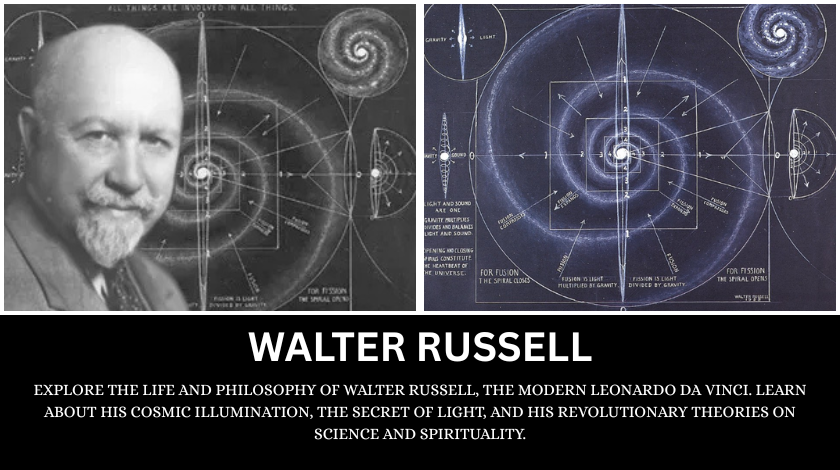
There is a name that often gets whispered in the halls of alternative science and deep philosophy, yet you rarely hear it mentioned in a standard history classroom. That name is Walter Russell. For a long time, I wondered why such a prolific human being was tucked away in the shadows of giants like Albert Einstein or Nikola Tesla. After all, Russell was a man who mastered almost every field he touched. He was a world-class painter, a sculptor who captured the likeness of presidents, an architect, a champion figure skater, and a scientific theorist whose ideas were so far ahead of his time that we are only just now starting to catch up. People often call him the “Modern Leonardo da Vinci,” and the more you look into his life, the more you realize that title is actually quite an understatement.
My personal connection to this topic started a few years ago when I was going through a period of deep questioning. I felt like the standard scientific explanations for how the world works were a bit hollow. They told me about atoms and gravity, but they didn’t explain the “soul” of the matter. I happened to find an old, weathered copy of a book called The Secret of Light. At first, the diagrams looked like something out of a science fiction movie from the 1920s. But as I read his words, something shifted. Russell didn’t talk about the universe as a cold, dead machine. He talked about it as a living, breathing expression of a divine mind. It was the first time I felt like science and spirituality were finally shaking hands rather than fighting for dominance.
The Man of Many Talents: A Biography
To understand the message, you have to understand the man. Walter Russell was born in 1871 in Boston, and his life story is a testament to the power of the human spirit. He didn’t come from a wealthy family; in fact, he had to leave school when he was only nine or ten years old to help support his family. Most people would see that as a massive disadvantage, but for Russell, it seemed to be a blessing. Because he wasn’t sat in a classroom being told what was “impossible,” his mind remained open to the infinite possibilities of nature. He began his career as an illustrator and quickly rose to become one of the most famous artists in America. If you look at his portraits of figures like Mark Twain, you can see a certain life in the eyes that most artists simply can’t capture.
But he didn’t stop at painting. Russell was a builder who helped design the concept of cooperative apartment living in New York City. He was a man who worked with IBM and served as an advisor to the business world. He believed that the same principles of balance that made a painting beautiful could also make a business successful. It is truly mind-blowing to think about one person achieving so much in a single lifetime. He lived to be 92 years old, and right up until the end, he was full of vitality. He once said that “mediocrity is self-inflicted and genius is self-bestowed.” I love that quote because it puts the responsibility for our own greatness squarely on our shoulders. He lived his life as a living example of that philosophy, showing us that we are only limited by the boundaries we set for ourselves.
The 39 Days of Light: The Illumination
The real turning point in Russell’s life happened in May of 1921. Up until this point, he was already a very successful man, but he was still searching for a deeper truth. He describes having a mystical experience that lasted for thirty-nine days. During this time, he claimed his consciousness was fully severed from his physical body and he was “in the light.” Now, to a modern skeptic, this might sound like a mental breakdown or a hallucination. But when you look at the volume of complex scientific and philosophical work he produced immediately after this experience, it is hard to dismiss. He came out of those thirty-nine days with a complete understanding of the chemical elements, the nature of gravity, and the workings of the solar system.
This experience changed him from a successful artist into a scientific philosopher. He spent the next forty years trying to translate what he “saw” into language that the rest of us could understand. He claimed that during his illumination, he saw the “stillness” that sits at the center of all motion. He realized that the universe is not made of “things,” but of rhythms and vibrations. This is a massive shift in perspective. Instead of looking at a rock as a solid object, he saw it as a temporary state of motion. He began to write The Universal One, a book so complex that he initially sent it to the top scientists of the world, including some at the Nobel level. Many didn’t know what to make of it because he wasn’t using the standard mathematical language of the time. He was using the language of light.
The Core of Russellian Science
What exactly is Russellian Science? At its heart, it is the idea that everything in the universe is made of light. This isn’t just a poetic metaphor; Russell meant it quite literally. He argued that what we call “matter” is just light that has been compressed into a tight spiral of motion. When that motion slows down or expands, the matter “disappears” or dies, but the light itself never goes away. He spoke of the “Void” or the “Zero Point,” which is the source of everything. Think of a movie projector. The screen shows all kinds of action—explosions, people running, beautiful landscapes—but if you turn off the film, there is only the steady, white light of the bulb. Russell believed that God, or the Universal Mind, is that steady light, and our physical world is the movie being projected.
Another fascinating part of his science is the concept of the spiral. If you look at a hurricane, a galaxy, or even the way water drains in your sink, you see a spiral. Russell believed that the spiral is the fundamental way that energy moves in our universe. He rejected the idea that the universe is “dying” or running out of energy. Traditional science tells us about entropy—the idea that everything is winding down into coldness. Russell disagreed entirely. He said that for every bit of energy that expands and “dies,” an equal amount of energy is being compressed and “born.” It is a continuous, eternal cycle. This brings a much more hopeful and energetic view of the world than the one we are usually taught in school.
Rhythmic Balanced Interchange: The Law of Love
If I had to pick one concept from Walter Russell that has had the biggest impact on my personal life, it would be Rhythmic Balanced Interchange. He often called this the “Law of Love.” It sounds very mystical, but it is actually a very practical way to live. The idea is that the universe is built on a system of equal giving and regiving. Notice he didn’t say “giving and taking.” He believed that “taking” was a violation of natural law. In nature, when the sun gives its heat to the ocean, the ocean “regives” that energy by creating clouds that eventually rain back down onto the earth. There is no hoarding in nature. Everything is in constant motion, moving from one state to another.
When we apply this to our daily lives, it changes everything. I’ve noticed that when I am feeling stressed or stuck, it is usually because I am out of balance. Maybe I am working too hard without resting, or maybe I am taking more than I am giving in a relationship. Russell taught that if you want to be successful, you must first give of yourself completely, and the universe will naturally “regive” back to you in equal measure. It is a beautiful way to look at human interaction. It suggests that greed is not just a moral failing, but a scientific mistake. If you try to stop the flow of energy, you eventually create a “blockage” that leads to decay. Staying in that rhythmic flow is the secret to a happy and productive life.
The Russell Periodic Table vs. Traditional Science
One of the most controversial parts of Russell’s work was his version of the periodic table. If you remember chemistry class, the periodic table is a big rectangular grid. Russell thought this was completely wrong. He designed a spiral periodic table where elements were organized by their “octaves,” much like musical notes. He believed that elements aren’t different “things,” but are just different pressures of light. He even predicted the existence of elements like Deuterium, Tritium, Neptunium, and Plutonium years before they were officially “discovered” by mainstream science. It’s hard to call someone a “crank” when they are accurately predicting the building blocks of the physical world.
He also had a very different view of the atom. While the science of his day (and ours) sees the atom as a central nucleus with electrons orbiting it, Russell saw it as a miniature version of a solar system, held together by electric potential. He was a huge critic of the “dead universe” theory. He didn’t believe in things like the “Big Bang.” Instead, he saw the universe as a continuous process of creation that has no beginning and no end. He felt that the science of the 20th century was too focused on the “seen” world of effects and was ignoring the “unseen” world of causes. For Russell, the cause of everything was the Mind of the Creator, and electricity was the tool used to carve matter out of the stillness.
Swannanoa and the Legacy of Lao Russell
In the latter half of his life, Walter Russell met a woman named Daisy “Lao” Cook. She became his wife and his creative partner. Together, they founded the University of Science and Philosophy. They moved to a place called Swannanoa in Virginia, which is a stunning Italian Renaissance-style marble palace built on the top of a mountain. I have seen pictures of this place, and it looks like it belongs in the hills of Tuscany rather than the Blue Ridge Mountains. This became the headquarters for their work, and for many years, they ran a correspondence course that was sent out to thousands of people all over the world.
Lao Russell was a powerhouse in her own right. She helped organize Walter’s complex ideas into a format that regular people could understand. She also wrote her own books on the power of love and the importance of women in the coming age. After Walter passed away in 1963, Lao continued their work for many more years, ensuring that the books and sculptures were preserved. Today, the University of Science and Philosophy still exists, and they have recently moved to a new location where they continue to publish Walter’s books and host events. It is heartening to see that even sixty years after his death, his ideas are still finding a new audience of seekers and thinkers.
Why Walter Russell Matters Today
You might ask, “Why should I care about a guy who wrote about light a hundred years ago?” I think the answer lies in the current state of our world. We are living in a time of great division, where science and spirituality often seem like they are at war with one another. Walter Russell offers a bridge between these two worlds. He shows us that you can be a rigorous thinker and a deeply spiritual person at the same time. His work is also very relevant to the growing interest in “Electric Universe” theories. Many people are starting to question the gravity-only models of the universe and are looking at the role of plasma and electricity in the cosmos. Russell was talking about these things in the 1920s.
Furthermore, his teachings on human potential are more needed than ever. In a world where we are often told that we are just biological accidents or cogs in a machine, Russell reminds us that we are creators. He believed that every human being has a “genius” within them, and that our job is to uncover it. He didn’t think he was a “special” person who was chosen by God to receive these messages. He thought he was a “normal” person who had simply learned how to get his own ego out of the way so that the universal mind could speak through him. That is an incredibly empowering message for anyone who feels like they are not living up to their full potential.
Conclusion
In the end, Walter Russell was a man who refused to be put in a box. He was an artist who could see the science in a sunset and a scientist who could see the art in an atom. His life and work serve as a reminder that the universe is a place of infinite beauty and perfect balance. Whether you are interested in his spiral periodic table or his philosophy on the “Law of Love,” there is something in his work for everyone. I truly believe that as we move forward into a new era of understanding, the name Walter Russell will become more and more prominent. He was a pioneer who walked the path of the future long before the rest of us even knew the path existed. By studying his “Secret of Light,” we might just find the spark we need to light our own way.
FAQ
1. Was Walter Russell a scientist?
While he didn’t have a formal degree in science, he was a deep student of the natural world. He used his observations and his mystical experiences to create a unique system called “Russellian Science.” Many of his predictions about chemical elements were later proven correct.
2. What is the most famous book by Walter Russell?
The Secret of Light is generally considered his most accessible and famous work. For those looking for a deeper, more technical dive, The Universal One is the definitive text of his scientific theories.
3. Did he really know famous people like Nikola Tesla?
Yes, Russell was well-connected. It is often reported that Nikola Tesla once told Russell to “lock his works in a safe for a thousand years” because humanity wasn’t ready for them. He was also friends with Mark Twain and various business leaders of his era.
4. Can I visit his home in Swannanoa?
Swannanoa Palace still stands in Virginia. While it is no longer the headquarters of the University of Science and Philosophy, it is sometimes open for tours and special events. The University itself has a museum and office in Waynesboro, Virginia.
5. How do his ideas relate to “The Law of Attraction”?
Russell’s ideas are much deeper than the modern “Law of Attraction.” While he believed our thoughts create our reality, he emphasized that this must be done through “Rhythmic Balanced Interchange”—meaning we must give as much as we expect to receive. It is more about harmony with natural law than just “manifesting” things for yourself.