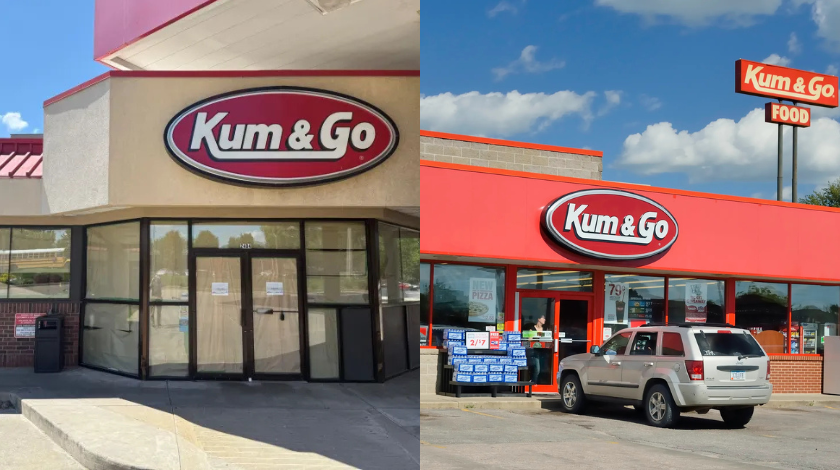
I still remember the first time I noticed something was off. I pulled into my usual Kum & Go on the way to work—something I’d done maybe three hundred times before—and the sign looked different. The familiar red-and-yellow logo that had greeted me since I was a kid, gassing up my first car, was suddenly covered in scaffolding. By next week, it was gone entirely, replaced by something called “Maverik” with a mountain silhouette I’d never seen before—no warning, no goodbye, just… gone.
If you’ve driven through the Midwest or Mountain West lately, you’ve probably noticed the same thing. The Kum & Go stores that have been as reliable as cornfields in Iowa are vanishing. Not just changing hands—disappearing completely. The name that started as a slightly embarrassing pun in 1959 is being systematically erased from the American landscape, store by store, sign by sign, until nothing remains but the memories of millions of customers who grew up with that distinctive branding.
So what actually happened? Why is a chain with over 400 locations and 60 years of history being phased out entirely? And why did the new owners decide to kill a brand that had become part of the cultural fabric of eleven states?
The Billion-Dollar Deal That Changed Everything
The story really begins in April 2023, when Maverik—an adventure-themed convenience store chain based in Salt Lake City, Utah—announced it was acquiring Kum & Go for approximately $2 billion.. The deal officially closed that August, transferring ownership from the Krause family—who had built the business across four generations—to FJ Management, the parent company of Maverik owned by the Maggelet family.
At the time, the two chains were remarkably similar in size. Maverik ranked 21st among U.S. convenience store chains with 404 locations in 12 states, while Kum & Go sat at 22nd with 397 stores across 11 states. Both were family-owned operations with strong regional identities. Both had invested heavily in fresh food programs and loyalty rewards. On paper, it looked like a merger of equals, or at least a combination that could preserve what made each chain special.
Maverik initially suggested they might keep both brands running. Chuck Maggelet, Maverik’s CEO, told industry publication NACS in April 2023 that they thought they could “bring a lot of what’s really good about Maverik into the Kum & Go world without necessarily rebranding.”. Kyle Krause, the fourth-generation leader of Kum & Go, later told the Des Moines Register that Maverik had communicated to him during negotiations that they “intended to run both brands.”
That promise didn’t last long. By November 2024, Maverik announced it would rebrand all Kum & Go locations under the Maverik banner, with the complete phase-out scheduled for 2025. The Kum & name, which had survived for 66 years, would not survive its new corporate owner.
Why Maverik Decided to Kill the Brand
The decision to retire Kum & Go wasn’t made lightly, according to multiple sources familiar with Maverik’s strategy who spoke with CSP Daily News. After a comprehensive assessment of both chains, Maverik’s leadership concluded that their own brand “resonated more impactfully in its markets than Kum & Go did in the heart of its Midwestern terrain.”
There’s also the uncomfortable reality of the Kum & name itself. One former Maverik employee admitted what many people have quietly joked about for decades: “I think there was some concern about the inadvertent double entendre of the Kum & Go name.”. When you’re trying to build a national brand that appeals to families and corporate partners, having a name that sounds like a crude joke probably doesn’t help.
But the bigger picture is about ambition. Maverik isn’t just buying Kum & Go to maintain it—they’re using it as a launchpad for national expansion. “Their big-picture plans are for further acquisitions and market expansion,” one source explained. “It’s probably easier to focus on one brand for efficiencies and brand/consumer awareness across the country.”. When you’re trying to grow cross-regionally, managing two separate brands, supply chains, marketing campaigns, and loyalty programs creates unnecessary complexity.
The numbers tell part of the story. Maverik now operates approximately 755 stores across 21 states, making it one of the largest privately owned convenience retailers in the United States. That scale gives them negotiating power with suppliers, greater distribution efficiency, and the ability to invest in technology and foodservice programs that smaller chains can’t match. From a business perspective, unifying under one brand makes sense. But business sense doesn’t always account for the emotional connections people form with the places they visit every day.
The Family Story Behind the Sale
To understand why Kum & Go disappeared, you have to understand the Krause family—and where their attention was focused when the deal was made.
Kum & Go was founded in 1959 by Bill Krause and his father-in-law, Tony Gentle, though the name “Kum & Go” (a play on “come and go”) wasn’t adopted until 1963. What started as a single store in Hampton, Iowa, grew into a Midwestern institution under four generations of family leadership. By the time the sale to Maverik occurred, Kyle Krause—Bill’s grandson—controlled the financial decisions, while his son, Tanner, served as CEO and ran daily operations.
But here’s where it gets interesting. Kyle Krause had developed passions that had nothing to do with convenience stores. He had invested heavily in Italian vineyards and, more significantly, purchased a 90% ownership stake in Parma Calcio 1913, an Italian soccer team, back in 2020. He was also pursuing a $500 million development project in downtown Des Moines that included a professional soccer stadium. “Kyle’s passion has always been soccer,” a source close to the family told CSP Daily News. “If there was a victim in all of this, it was their convenience chain.”
Tanner Krause, by all accounts, loved running Kum & Go. He had been bringing his own culture to the company, including outreach to the African-American and LGBTQ+ communities. But when your controlling owner wants to fund soccer stadiums and Italian football clubs, and a buyer offers $2 billion, the family business becomes a liquidation asset.
The sale made Kyle Krause wealthy enough to pursue his dreams. It made FJ Management wealthy enough to build a national convenience store empire. And it made 5,000 Kum & Go employees—who were kept on by Maverik as part of the deal—part of a company they never chose to work for.
What This Means for Regular Customers
If you were a Kum & Go regular, the transition hasn’t been seamless. Maverik has approached the rebranding market by market, with stores experiencing brief closures during the changeover. In Oklahoma, all 41 stores were scheduled to complete their transition by mid-2025. In Arkansas, specific dates were announced for each location—like the Bono store closing July 25, 2025, at 6 p.m. and reopening as Maverik July 29 at 6 a.m.
Not every store survived the transition. In Springfield, Missouri, Maverik permanently closed at least two locations in 2025—the store at 2410 E. Sunshine St. and another at 620 N. National Ave.. These weren’t random underperformers; they were two of the remaining three 1980s-era Git n’ Go stores that Kum & Go had acquired decades earlier. Maverik told local reporters they “made the decision to close select stores to re-invest in areas that will better serve even more Springfield customers.”. Translation: Some locations weren’t worth the cost of rebranding.
Other stores were sold off entirely. Casey’s General Stores acquired multiple Kum & Go locations in South Dakota and Michigan. Mega Saver purchased more than 20 locations in two states. The original 400-store network is being parceled out, rebranded, or shuttered based on strategic value rather than community connection.
For loyalty program members, the transition has been particularly frustrating. Kum & Go’s “&Rewards” program is being replaced by Maverik’s “Adventure Club” and “Nitro” rewards. While accounts remain active during the transition, points and rewards don’t transfer to the new system. Customers were told to “plan to use up &Rewards at their local store before rebranding.”
—effectively forcing them to spend their accumulated benefits or lose them.
The food service has changed, too. Kum & Go had built a reputation for its fresh-made food program, but Maverik has replaced it with its “BonFire” kitchen concept. Whether that’s an improvement depends on who you ask, but it’s different—and for customers who had their routines, different is disruption.
The Bigger Picture: What This Says About American Retail
The death of Kum & Go isn’t just about one convenience store chain. It’s part of a larger consolidation wave reshaping American retail, particularly in the convenience and fuel sectors. In 2024 alone, Tri Star Energy acquired Cox Oil, Offen Petroleum purchased Douglass Distributing, and Par Mar Oil bought Santmyer Companies. Larger players with private equity backing and national ambitions are absorbing smaller regional chains.
There’s something lost when this happens. Kum & Go wasn’t perfect—no corporate chain is—, but it was local in a way that Maverik isn’t. It was founded by an Iowa family, headquartered in Des Moines, and deeply embedded in the communities it served for 66 years. When you buy a cup of coffee at a Maverik, you’re buying from a Utah-based company owned by FJ Management, which itself exists because of the sale of Flying J truck stops to Berkshire Hathaway. The money flows west, then up to corporate investors. The local connection is severed.
This matters because convenience stores aren’t just retail locations—they’re community infrastructure. In small towns across Iowa, Missouri, Arkansas, and Oklahoma, the Kum & Go was often the only place open 24 hours, the only place to get gas at 2 a.m., the only place with a public restroom for miles. When these stores become homogenized under a single national brand, they lose their connection to place. The Maverik in Jonesboro, Arkansas, looks identical to the Maverik in Salt Lake City, which looks identical to the Maverik in wherever they expand next. The regional character that made Kum & Go distinctly Midwestern is being replaced by a generic “adventure” aesthetic that could be anywhere.
A Personal Take on Corporate Homogenization
I get why Maverik did this. I really do. If I were running a business and saw an opportunity to nearly double my store count overnight, unify my branding, and eliminate redundant costs, I’d probably make the same call. The fiduciary duty to shareholders—or in this case, family owners—demands it.
But as a customer, as someone who grew up in the Midwest and remembers when regional brands meant something, I can’t help but feel like we’re losing something important. Every time another Kum & Go comes down, every time another local name is replaced by national branding, the landscape becomes a little more generic. A little more of the same. A little less here.
The Krause family got their money. Maverik got their empire. Most employees kept their jobs. But the customers—the millions of people who stopped at Kum & Go on road trips, who grabbed breakfast sandwiches on their way to work, who filled up there because it was their gas station—didn’t get a vote. We just got to watch it happen, one store at a time, until there’s nothing left but the memories.
And honestly? That’s worth mourning, even if it was inevitable.
Conclusion
The Kum & Go brand is being systematically eliminated by its new owner, Maverik, following a $2 billion acquisition that closed in August 2023. What began as a promise to run both brands evolved into a complete rebranding strategy, with approximately 400 locations converted to Maverik stores by the end of 2025. While some locations have been sold to other chains like Casey’s or permanently closed, the majority are being rebranded with new signage, new loyalty programs, and new food service concepts. For customers, this means the end of a 66-year Midwestern institution and the continuation of a broader trend toward national consolidation in convenience retail.
Frequently Asked Questions
Is Kum & Go going out of business completely? Not exactly—most locations are being rebranded as Maverik stores rather than closed. However, the Kum & name is being retired entirely, and some underperforming locations have been permanently shuttered or sold to other chains like Casey’s.
Why did Maverik buy Kum & Go just to change the name? Maverik acquired Kum & Go primarily for its locations and market presence, not its brand identity. After analyzing both chains, Maverik determined that its own brand had a stronger national appeal and that operating a single, unified brand would be more efficient for future expansion.
What happens to my Kum & Go rewards points? The &Rewards program is being discontinued. Points do not transfer to Maverik’s new loyalty programs (Adventure Club and Nitro). Customers were advised to use their accumulated rewards before their local store rebranded.
When will the rebranding be complete? Maverik completed the majority of Kum & Go rebrands by late 2025, though some exterior signage updates may continue into early 2026, depending on the location.
Why did the Krause family sell Kum & Go? Multiple factors influenced the sale, including Kyle Krause’s desire to pursue other investments—particularly Italian soccer team Parma Calcio and a Des Moines soccer stadium development—and the attractive $2 billion purchase price offered by FJ Management.