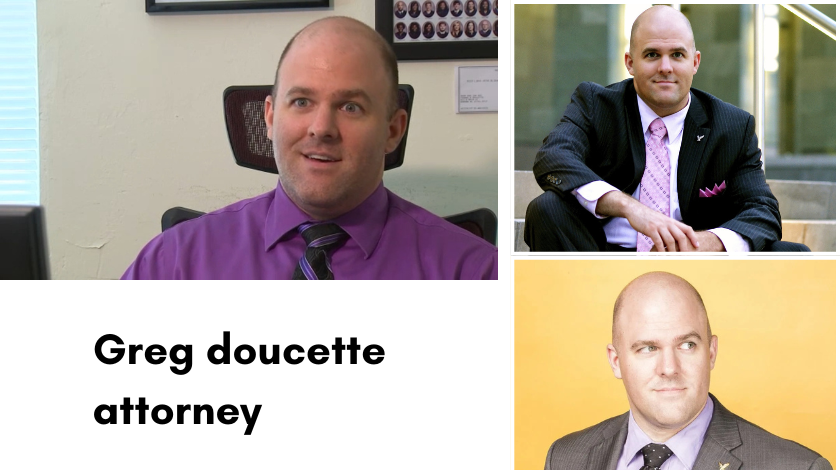
Greg Doucette Attorney: Inside the Career of Durham NC’s Most Unconventional Lawyer
When you think about criminal defense attorneys in North Carolina, certain stereotypes might come to mind. But T. Greg Doucette breaks every single one of them. Here is a lawyer who built his reputation defending protesters and drug offenders while running for office as a Republican. He documented police misconduct viral videos while identifying as a conservative. He transitioned from a decade of courtroom battles to a role as corporate counsel at one of the world’s largest tech companies. If you are trying to understand who Greg Doucette is as an attorney, you need to throw away your assumptions about what a lawyer should look like, sound like, or believe in.
I have been following Doucette’s career for several years now, and what strikes me most is how genuinely unconventional his path has been. Most attorneys follow predictable trajectories: law school, associate position at a big firm, a partnership, or a government role. Doucette did none of that. Instead, he stumbled into law after a career in information technology, faced homelessness during his undergraduate years, and built a practice that became famous for defending the very people his political party often criticized. This is not your typical legal career, and that is exactly why it matters.
From Homelessness to Law School: An Unlikely Beginning
Greg Doucette’s story starts with a hardship that most law students never experience. Born in 1981 and raised in Virginia Beach, Virginia, Doucette grew up in a household marked by conflict between his mother and stepfather. His parents divorced during his youth, leaving him with instability that would follow him into early adulthood. When he enrolled at North Carolina State University in 1998, his family disapproved of his choice, creating tension over both his educational direction and financial support.
The financial pressure became overwhelming. After his sophomore year, Doucette dropped out of NC State, and for several months, he experienced homelessness. This is not the typical background for someone who would later become a Super Lawyers Rising Star. Most successful attorneys come from stable backgrounds with resources to support their education. Doucette had to fight for every step.
But he returned to NC State in 2005, completed his Bachelor of Science in computer science in 2009, and immediately pivoted to law school at North Carolina Central University. What is fascinating here is his reasoning: he chose NCCU because it was cheaper than the University of North Carolina at Chapel Hill. Practical financial thinking guided his decision, not prestige or tradition. He graduated cum laude in 2012 with concentrations in biotechnology law, intellectual property, and criminal law, and he was sworn in as an attorney that same year.
During his time at NC State, Doucette developed leadership skills that would serve him throughout his career. He served two terms as Student Senate President and became President of the UNC Association of Student Governments. He even created the university’s first student fee referendum, allowing students to vote directly on fee increases. This early experience with democratic processes and student advocacy foreshadowed his later work in political and legal activism.
Building a Practice in Durham: The Accidental Criminal Defense Attorney
Doucette never intended to become a criminal defense lawyer. When he founded the Law Offices of T. Greg Doucette PLLC in Durham in 2012, he focused on business litigation and higher education law. These areas made sense given his background in computer science and experience with university governance. He planned to start a nonprofit called “NC SPICE” to help other attorneys establish their practices, complete with a clever logo featuring a pepper grinder with scales of justice.
But life had other plans. In November 2013, a client walked into his office who would change the trajectory of his entire career. The client was an NCCU student caught selling marijuana, and during their first conversation, he told Doucette that he wanted to become “Durham’s weed man.” He even brought a business plan with marketing projections and a color-coded map showing where marijuana was legal across the country.
Doucette remembers this as a “record-scratch moment” where everything froze. He thought the case was impossible to win. But he took it anyway, and in February 2014, he successfully argued to suppress the evidence, getting the case dismissed entirely. In the courthouse hallway afterward, the client grabbed his arm and called him “white Jesus.” More importantly, the client started sending other defendants to Doucette’s office.
By mid-2015, Doucette had become the go-to defense attorney for marijuana sellers in a significant part of Durham. This is how criminal defense practices often grow: not through marketing or networking, but through results and word of mouth in the community. The clients Doucette defended were not wealthy or powerful. They were ordinary people facing serious consequences for nonviolent offenses, and Doucette treated them with respect and fought hard for their rights.
First Amendment Crusader: Defending Protesters and Free Speech
What truly set Doucette apart from other criminal defense attorneys was his specialization in First Amendment litigation and the defense of protesters. Between 2014 and 2016, he provided pro bono representation to nearly 100 individuals arrested during protests, including flag-burning incidents following the 2016 presidential election. His record was remarkable: only two convictions out of all those cases, with the vast majority ending in dismissals or acquittals.
This work was not profitable. It was dangerous to his reputation in conservative circles. But Doucette approached it as his “ministry.” He believed that defending protesters was about protecting constitutional rights, not supporting any particular political agenda. This distinction is crucial to understanding his philosophy: he saw himself as fighting government overreach, whether that meant police misconduct or prosecutorial abuse of power.
One of his most significant cases was Sharpe v. Winterville Police Department, which addressed the First Amendment right to record police interactions. Doucette represented Dijon Sharpe, who was stopped by police and attempted to livestream the encounter. The case established important precedent regarding citizens’ rights to document law enforcement activities, while also highlighting the qualified immunity doctrine that protects officers from liability.
Doucette also developed expertise in anti-SLAPP defense, protecting clients from strategic lawsuits against public participation. These cases involve powerful entities using litigation to silence critics, and Doucette reportedly never lost such a case during his decade of practice. This work required not just legal knowledge but strategic thinking about how to protect free speech while managing complex litigation against well-funded opponents.
The Police Misconduct Database: Viral Impact and National Recognition
If you know Greg Doucette’s name, it is probably because of his work documenting police misconduct. In May 2020, following the killing of George Floyd and the nationwide protests that followed, Doucette started a Twitter thread linking to videos of police violence against protesters and journalists. What began as a simple curation effort exploded into something much larger.
Working with Jason Miller, a mathematics professor at California State University, Doucette created collaborative spreadsheets that eventually contained over 800 documented incidents. The Twitter thread received millions of views and was featured in Time magazine, The Verge, and numerous other national publications. Out-of-state police misconduct investigators contacted him to review video evidence and take appropriate action.
This work was exhausting and controversial. Doucette received approximately 1,600 messages that he could not even open due to volume. Pro-police advocates accused him of selectively highlighting misconduct to fuel anti-law enforcement narratives. But Doucette’s response was consistent with his philosophy: he was documenting evidence of systemic issues, not attacking individual officers. As a self-identified conservative and former Republican, he argued that police accountability was fundamentally a conservative value about limiting government power.
The database represented a new form of legal advocacy: using social media and crowdsourcing to create accountability mechanisms outside traditional institutional channels. Doucette’s background in computer science served him well here. He understood how to organize data, verify sources, and present information in ways that would gain traction online. This was not traditional legal work, but it was deeply rooted in legal principles of evidence and documentation.
Political Campaign and the Cost of Public Life
In 2016, Doucette made what he later called an “incredibly stupid” decision: he ran for North Carolina State Senate as a Republican in District 22, which includes Durham County. This was a Democratic stronghold where Republicans rarely won, but Doucette believed he could make a difference by advocating for criminal justice reform, limited government, and economic opportunity.
His platform was genuinely unusual for a Republican candidate. He supported raising the age of automatic adult prosecution from 16 to 18, noting that North Carolina was the only state treating 16-year-olds as adults by default. He advocated decriminalizing possession of under one ounce of marijuana. He proposed expanding diversion programs for nonviolent first-time youth offenders and mandating automatic special prosecutors for officer-involved shootings. These positions aligned him more closely with Black Lives Matter protesters than with traditional Republican law-and-order rhetoric.
Doucette lost badly to incumbent Democrat Mike Woodard, receiving 34.4% of the vote to Woodard’s 65.6%. But the campaign’s impact on his law practice was devastating. By focusing on campaigning instead of client development, his business crumbled. His associate attorneys left. He spent 2017 in what he described as a “rat race of churning through cases to make rent each month.” This experience illustrates the genuine financial vulnerability of solo practitioners and the risks of mixing political ambition with legal practice.
Despite the loss, the campaign revealed Doucette’s willingness to take principled stands regardless of political cost. His platform emphasized “liberty and justice for all” and sought to transcend partisan divides. This was not cynical politicking; it was a genuine attempt to apply his legal principles to policy-making, even when it alienated potential allies.
Closing the Firm: Transition to GitHub and Corporate Law
On June 7, 2022, the Law Offices of T. Greg Doucette PLLC officially closed its doors after ten years of service to the Durham community. The closure marked the end of an era for local legal services and left many wondering what would happen to Doucette’s unique practice.
The answer came quickly: Doucette transitioned to an in-house corporate role as Principal Commercial Counsel at GitHub, Inc., the Microsoft subsidiary that operates the world’s largest software development platform. Based in Durham, he joined the company’s Cybersecurity and Online Safety team, advising on technology policy, content moderation, and legal risks associated with online platforms.
This move made perfect sense given his background. Doucette had been a software developer before becoming a lawyer, and his decade of litigation experience gave him insight into the legal challenges tech companies face. His work at GitHub involves proactive corporate counseling rather than adversarial courtroom litigation, a significant shift in both daily work and professional identity.
By 2025, Doucette had advanced to Senior Commercial Counsel, contributing to initiatives involving AI tools like Copilot and platform safety measures. This career trajectory is increasingly common among trial attorneys seeking greater work-life balance and strategic influence. Still, Doucette’s transition was particularly smooth because of his technology background and experience with internet law, including the DMCA and content moderation.
Professional Recognition and Community Impact
Despite his unconventional path, Doucette received significant professional recognition during his years in private practice. He was selected to the Rising Stars list for 2019 through 2022, a designation given to top-rated attorneys as recognized by their peers through the Super Lawyers selection process. He also received the American Society of Legal Advocates’ Top 40 Under 40 in Litigation award in 2016, was named to Business North Carolina’s Legal Elite for three consecutive years (2014-2016), and received North Carolina Lawyers Weekly’s Leaders in the Law recognition in 2015 and 2016.
Beyond legal practice, Doucette maintained a deep commitment to the community. Since 2015, he organized an annual fundraiser to provide groceries for underprivileged elementary school children in Durham. In 2020, he raised over $55,000 and secured an 18-wheeler from Lowe’s to transport 3,642 bags of groceries. He served on multiple nonprofit boards, including the Achievement Academy of Durham, the Durham Jaycees, and the Boys and Girls Club of the Salvation Army of Durham.
His former clients often returned to thank him not just for legal representation but for personal advice and genuine care. This is the highest compliment any attorney can receive: being treated as a human being rather than a case file. Doucette’s ability to connect with people from all walks of life, from college students selling marijuana to protesters facing felony charges, speaks to his fundamental approach to law as a service to individuals rather than an abstract system.
Why Greg Doucette’s Career Matters for Modern Legal Practice
Understanding Greg Doucette’s career offers lessons for anyone interested in the legal profession, whether you are a prospective law student, a practicing attorney, or someone seeking legal representation. His path demonstrates that success in law does not require following traditional templates. You can build a practice around your values, specialize in areas that matter to you personally, and transition between different types of legal work throughout your career.
Doucette’s work also illustrates the changing nature of legal advocacy in the digital age. His police misconduct database showed how attorneys can use technology and social media to create accountability outside traditional legal channels. His transition to GitHub demonstrates how litigation experience can translate into valuable expertise for technology companies navigating complex regulatory environments.
For clients, Doucette’s career highlights the importance of finding attorneys who genuinely care about their cases and are willing to fight creatively for their rights. His success rate in criminal defense came not from connections or resources but from thorough preparation, strategic thinking, and a willingness to challenge evidence and procedures. His pro bono work for protesters showed that some attorneys will take cases because they believe in the cause, not just the paycheck.
If you are looking for legal representation in Durham or North Carolina today, you cannot hire Greg Doucette directly anymore. His firm is closed, and he is no longer in private practice. However, the North Carolina Bar Association’s Lawyer Referral Service at (919) 677-8574 can connect you with qualified attorneys in the areas where Doucette once practiced. Look for lawyers who share his commitment to client service, his willingness to take difficult cases, and his creative approach to legal problems.
Greg Doucette’s career reminds us that the best attorneys are often those who bring diverse experiences to their practice, who maintain their principles even when costly, and who see law as a tool for helping real people navigate difficult situations. Whether defending a college student selling marijuana, documenting police misconduct during national protests, or advising a tech giant on content moderation, Doucette has consistently applied the same core values: skepticism of government power, commitment to individual rights, and genuine care for the people he serves. That is a legacy worth remembering, even as his active practice has moved in new directions.
Conclusion
T. Greg Doucette’s journey from a homeless college student to a recognized criminal defense attorney and, now, to corporate counsel at GitHub, represents one of the most unconventional legal careers in modern North Carolina history. Over ten years of private practice in Durham, he defended hundreds of clients in criminal cases and First Amendment litigation, maintained a remarkable success rate, and built a reputation for principled advocacy regardless of political cost. His police misconduct documentation during the 2020 protests brought national attention to his work, while his 2016 Senate campaign demonstrated both his political ambition and the financial risks it posed to his practice.
The closure of his law firm in 2022 marked not an end but a transformation. Doucette now applies his legal expertise to technology policy and cybersecurity at GitHub, bringing his unique combination of litigation experience and computer science background to the corporate world. His career offers valuable lessons about resilience, the importance of authentic advocacy, and the evolving opportunities for legal professionals in both traditional practice and emerging tech sectors.
For those seeking legal representation today, Doucette’s legacy suggests looking for attorneys who combine technical skill with genuine care for clients, who are willing to take difficult stands on principle, and who view law as a service to individuals rather than merely a business. While you can no longer hire Doucette directly, his decade of work in Durham established standards for criminal defense and First Amendment representation that continue to influence the local legal community.
Frequently Asked Questions (FAQ)
Is Greg Doucette still practicing law? Yes, but not in private practice. As of June 7, 2022, the Law Offices of T. Greg Doucette PLLC permanently closed. Doucette currently works as Senior Commercial Counsel at GitHub, Inc., focusing on cybersecurity, online safety, and technology policy. He is no longer available for private client representation.
What type of law did Greg Doucette practice? During his private practice from 2012 to 2022, Doucette specialized in criminal defense, First Amendment litigation, business litigation, and higher education law. He was particularly known for defending protesters, handling drug offense cases, and protecting free speech rights. He also developed expertise in anti-SLAPP defense and police misconduct litigation.
Where did Greg Doucette go to law school? Doucette earned his Juris Doctor (J.D.) cum laude from North Carolina Central University School of Law in Durham, North Carolina, graduating in May 2012. He chose NCCU over UNC-Chapel Hill primarily for financial reasons. Before law school, he completed a Bachelor of Science in computer science at North Carolina State University in 2009.
What is Greg Doucette doing now? Doucette currently works as Senior Commercial Counsel at GitHub, Inc., a Microsoft subsidiary headquartered in San Francisco, but with Doucette working from Durham, North Carolina. He serves on the Cybersecurity and Online Safety team, advising on technology policy, content moderation, and legal risks associated with online platforms and AI tools like Copilot.
Was Greg Doucette a good attorney? Based on professional recognition and client reviews, Doucette was highly regarded as an attorney. He was selected to Super Lawyers Rising Stars from 2019 to 2022, received the American Society of Legal Advocates’ Top 40 Under 40 in Litigation award, and was named to Business North Carolina’s Legal Elite for three consecutive years. Client reviews on platforms like Avvo describe him as responsive, skilled, and passionate about helping vulnerable clients.
What was Greg Doucette’s police misconduct database? In May 2020, following the George Floyd protests, Doucette created a viral Twitter thread documenting videos of police violence against protesters and journalists. Working with a mathematics professor, he developed collaborative spreadsheets containing over 800 documented incidents. The database received millions of views, was featured in national media, and helped facilitate investigations into police misconduct.
Did Greg Doucette run for political office? Yes, Doucette ran as a Republican candidate for North Carolina State Senate District 22 in 2016. His platform emphasized criminal justice reform, limited government, and economic opportunity, including positions unusual for a Republican candidate, such as supporting marijuana decriminalization and raising the age of adult prosecution. He lost to incumbent Democrat Mike Woodard but received more votes than any previous Republican candidate for that seat.
How can I find a lawyer like Greg Doucette in Durham? Since Doucette’s firm closed, clients seeking similar representation should contact the North Carolina Bar Association’s Lawyer Referral Service at (919) 677-8574. Look for attorneys with experience in criminal defense, First Amendment, or business litigation who demonstrate a commitment to client service and principled advocacy.