When we think about the American Revolutionary War, we often picture small groups of farmers hiding behind stone walls or the snowy misery of Valley Forge. However, the Battle of Brandywine, fought on September 11, 1777, tells a much grander and more complex story. This was a massive clash of two professional armies involving nearly 30,000 soldiers. It was the largest single day of combat in the entire war, and the stakes could not have been higher. The British were making a move on Philadelphia, which was then the capital of the rebellious colonies. If Philadelphia fell, the British believed the revolution would collapse. I have always found this particular battle fascinating because it showcases both the brilliance of British military tactics and the incredible resilience of George Washington’s Continental Army. Even though the Americans lost the day, they didn’t lose their spirit, and that is a story worth telling in detail.
To understand why this battle happened, we have to look at the summer of 1777. General William Howe, the commander of the British forces, was a man who loved a good plan. Instead of marching across New Jersey to take Philadelphia, he decided to put his army on ships and sail around to the Chesapeake Bay. This was a long and exhausting journey for his men and their horses, but it allowed him to approach the capital from the south. Washington was kept guessing for weeks about where Howe would land. When the British finally stepped off their ships at a place called Head of Elk in Maryland, Washington knew he had to act fast. He moved his army to a small town called Chadds Ford in Pennsylvania. This location was vital because it sat right on the main road to Philadelphia, and the Brandywine Creek served as a natural barrier that Washington hoped to use to his advantage.
Washington’s strategy was fairly straightforward. He placed his troops at various crossing points along the Brandywine Creek, thinking he could stop the British from coming across. He concentrated most of his strength at Chadds Ford, which was the most direct route. I think it is important to realize that back then, the landscape was a mix of thick woods, rolling hills, and scattered farms owned by Quakers. The Quakers were mostly pacifists who didn’t want any part of the war, but their peaceful hills were about to become a bloody theater of conflict. Washington felt confident in his position, but he suffered from a major lack of good intelligence. He didn’t have enough scouts to cover all the upstream crossings, and this mistake would prove to be very costly as the day progressed.
On the morning of September 11, a thick fog covered the area, which added to the confusion. General Howe was a master of the “flanking maneuver,” a tactic where you send a small force to distract the enemy while your main army sneaks around the side. He sent a large column of Hessian and British troops toward Chadds Ford to start a noisy fight. This made Washington believe that the main attack was happening right in front of him. Meanwhile, under the cover of the fog and the trees, Lord Cornwallis led the majority of the British army on a grueling seventeen-mile march far to the north. They crossed the creek at unguarded points and prepared to slam into the side of the American line. It was a brilliant move that caught the Americans completely off guard.
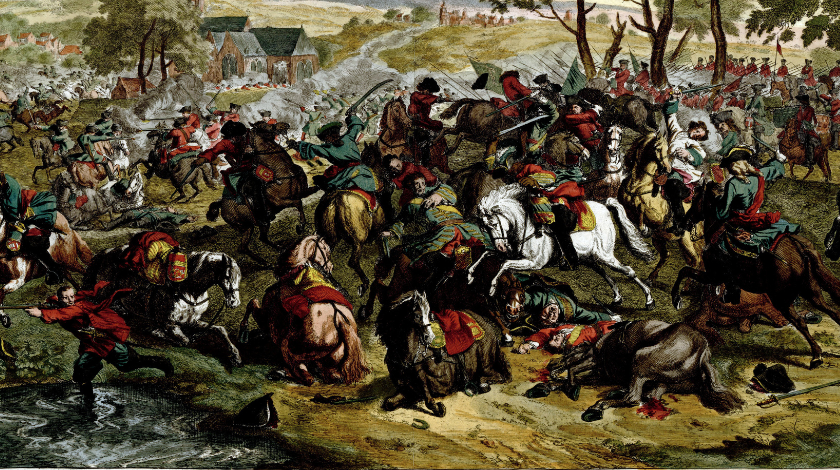
When news finally reached Washington that a massive British force was appearing on his right side near the Birmingham Friends Meeting House, the situation turned into a crisis. He had to quickly shift his troops to meet this new threat. Imagine the chaos of thousands of men trying to change their position while being attacked by professional soldiers. The fighting at Birmingham Hill was some of the most intense of the entire war. The Americans managed to form a line of defense, but they were being pushed back by the sheer discipline and firepower of the British regulars. This is where we see the true grit of the Continental Army. Despite being outmaneuvered, they stood their ground for several hours, engaging in fierce hand-to-hand combat and heavy artillery duels.
One of the most famous stories from this battle involves the Marquis de Lafayette. This was the young French aristocrat’s first real taste of combat. He had come to America because he believed in the cause of liberty, and Washington had taken him under his wing. During the retreat at Birmingham Hill, Lafayette was shot in the leg while trying to rally the panicked American troops. Instead of fleeing, he stayed on the field until the retreat was organized. I believe this moment was a turning mark for the relationship between France and the United States. Lafayette’s bravery proved to the Americans that they had a true ally, and his reports back to France helped secure more support for the war effort later on.
As the sun began to set, the American line finally broke. The British had won the field, but they were too exhausted from their long march and the day’s fighting to pursue Washington’s army and destroy it completely. Another hero of the day was Casimir Pulaski, a Polish officer who led a daring cavalry charge that covered the American retreat. His actions likely saved many lives and allowed Washington to move his men toward the town of Chester. By the end of the day, the Americans had lost about 1,100 men, while the British lost around 600. It was a clear defeat for Washington, and only two weeks later, the British marched triumphantly into Philadelphia.
However, the loss at Brandywine didn’t end the war. In fact, many historians, including myself, would argue that it showed how much the Continental Army had grown. A year earlier, a defeat like this might have caused the entire army to desert and go home. Instead, the men remained organized. They felt that they had stood toe-to-toe with the best army in the world and held their own for a long time. They blamed the loss on the flanking maneuver and poor intelligence rather than a lack of courage. This sense of pride was essential for surviving the brutal winter that was coming at Valley Forge. They knew they could fight; they just needed better training and better luck.
Today, if you visit the Brandywine Battlefield Park, you can feel the weight of history in the air. The rolling hills are still there, and the Birmingham Friends Meeting House still stands, with bullet holes and bloodstains occasionally mentioned in local lore. Walking through those fields gives you a sense of the scale of the battle. It is one thing to read about 30,000 men in a book, but it is another thing entirely to see the narrow roads and the steep hills they had to climb while carrying heavy equipment and muskets. The preservation of this land is vital because it reminds us of the sacrifices made by ordinary people who were caught in the middle of a global struggle for power and independence.
In my opinion, the Battle of Brandywine is often overshadowed by the victory at Saratoga or the surrender at Yorktown, but it deserves more attention. It was a masterclass in 18th-century warfare. It showed the importance of geography, the necessity of good intelligence, and the impact of charismatic leadership. It also highlighted the international nature of the war, with Germans fighting for the British and French and Polish officers fighting for the Americans. The story of Brandywine is a story of a young nation learning how to fight on the fly. They lost the capital, but they saved the army, and in a war of revolution, as long as the army exists, the cause is still alive.
When we look back at Washington’s role, we have to be honest about his mistakes. He was outfoxed by Howe and Cornwallis. He failed to secure his flanks, and he relied on conflicting reports from his scouts. But his greatest strength was never his tactical brilliance; it was his ability to keep his men together after a loss. He didn’t panic. He led a disciplined retreat and kept the army’s morale from bottoming out. That is what a real leader does. He takes a bad situation and ensures it doesn’t become a total disaster. The Battle of Brandywine was a hard lesson, but it was one that the Americans took to heart as they continued their long journey toward independence.
Conclusion
The Battle of Brandywine stands as a monumental chapter in the American story. It was a day of smoke, fire, and tactical brilliance that tested the limits of the Continental Army. While the British successfully captured Philadelphia as a result of their victory, they failed to capture the American spirit or the American commander. The lessons learned on the banks of the Brandywine Creek paved the way for the eventual professionalization of the army at Valley Forge. Understanding this battle helps us appreciate the complexity of the Revolutionary War and the sheer determination required to forge a new nation. It wasn’t just about the victories; it was about how the Americans handled their defeats that truly defined the path to freedom.
Frequently Asked Questions
1. Who won the Battle of Brandywine?
The British Army, led by General William Howe and Lord Cornwallis, won the battle. They successfully outmaneuvered the American forces and forced them to retreat, which eventually allowed the British to occupy Philadelphia.
2. Why was the Battle of Brandywine significant?
It was the largest single-day battle of the American Revolution in terms of the number of troops engaged. It also marked the first time the Marquis de Lafayette saw combat and led to the British occupation of the American capital, Philadelphia.
3. How did the British outsmart George Washington at Brandywine?
General Howe used a flanking maneuver. He sent a small part of his army to distract Washington at Chadds Ford while the rest of his troops marched several miles north to cross the creek and attack the Americans from the side.
4. Where is the Brandywine battlefield located?
The battlefield is located near Chadds Ford, Pennsylvania, about 25 miles southwest of Philadelphia. Much of the site is preserved today as the Brandywine Battlefield Park.
5. What happened to the American army after the battle?
The American army retreated to Chester and then toward Philadelphia. Although they lost the battle and the city, the army remained intact and eventually went into winter quarters at Valley Forge to retrain.